

Is Black Treacle the Same as Molasses? A UK Guide
Is black treacle the same as molasses? Close, but not exactly. Black treacle is made from cane molasses blended with refiners syrup, so it isn't pure molasses. In baking it behaves like light or dark molasses and swaps 1:1. Blackstrap molasses is much more bitter, so don't use it in place of either.
At a glance
- 1:1 swapblack treacle for light or dark molasses in most bakes
- A blendLyle's Black Treacle is cane molasses plus refiners syrup
- Blackstrapthe third boil: darkest, most bitter, least sweet
- 67.2gcarbohydrate per 100g of black treacle (CoFID 17-826)
On this page
Is black treacle the same as molasses? It's one of the most common questions when a US gingerbread or baked beans recipe lands in a British kitchen. American recipes ask for molasses, often light, dark or blackstrap, while UK supermarkets sell black treacle in a tin next to the golden syrup. With Bonfire Night parkin and Christmas baking coming up, here's how they compare and when you can swap one for the other.
Is black treacle the same as molasses?
Not quite, although they're very close relatives. Molasses is the thick, dark syrup left behind when sugar is crystallised out of boiled sugar cane or sugar beet juice. King Arthur Baking, a US flour miller, explains that the sugar crystals are removed to be refined, and the syrup that remains is molasses.
Black treacle starts with that same cane molasses, but it isn't pure molasses. The ingredients on Tate & Lyle's specification for Lyle's Black Treacle are cane molasses plus partially inverted refiners syrup or sugarcane syrup. The maker describes it as a thick black syrup of sucrose, glucose and fructose, "also commonly described as a 'molasses'", with a powerful and slightly bitter flavour.
So black treacle is best thought of as a molasses blend. In a cake or biscuit dough, it and molasses do the same job: colour, moisture, stickiness and that dark, slightly bitter edge.
Even reference books blur the line. Wikipedia's molasses entry says molasses is "also called black treacle", while its treacle entry calls black treacle a darker variety "similar to molasses". Both are fair: one is a blend made from the other.
Treacle vs molasses vs golden syrup
In the UK, "treacle" covers two syrups made during sugar refining. Golden syrup is the pale one, and is also called light treacle. Black treacle is the dark one. Here's how treacle vs molasses vs golden syrup line up.
| Syrup | What it is | Flavour | Used in |
|---|---|---|---|
| Black treacle | Molasses plus syrup | Dark, slightly bitter | Parkin, toffee |
| Light molasses | First boil | Sweet, mild | US cookies |
| Dark molasses | Second boil | Stronger, less sweet | Gingerbread |
| Blackstrap | Third boil | Very bitter | Baked beans |
| Golden syrup | Refined invert syrup | Caramel, toffee | Flapjacks, tarts |
From Tate & Lyle's Black Treacle specification, King Arthur Baking, the World Sugar Research Organisation and Wikipedia. Uses are typical, not fixed rules.
The World Sugar Research Organisation (WSRO) describes treacle as a darker syrup with a very thick texture and a rich flavour with hints of liquorice and smokiness, used in baking, traditional puddings and savoury sauces or glazes. Golden syrup, by contrast, is made from liquid sugar and invert sugar and has a sweet caramel and toffee flavour. It was first made at Abram Lyle & Sons' London refinery and sold in tins from 1885.
That's why a treacle tart is golden, not black: it's made with golden syrup. A treacle toffee, also called bonfire toffee, is the opposite. Wikipedia notes it tastes very strongly of black treacle and is linked with Halloween and Bonfire Night.
Light, dark and blackstrap molasses explained
King Arthur Baking explains that the type of molasses depends on how many times the cane juice has been boiled and how much sugar has been taken out.
Light molasses
This is the first boil, with a delicate, sweet flavour. Some makers label it "regular", "mild", "original" or "Barbados" molasses. King Arthur calls light, unsulphured molasses the most versatile type to keep in the cupboard.
Dark molasses
Boil it again and you get dark, also sold as "full" or "robust", molasses. It's thicker and less sweet. King Arthur says it gives gingerbread its distinctive flavour and can be used in place of light molasses by anyone who wants a stronger taste.
Blackstrap molasses
The third and final boil gives blackstrap: very dark, thick and notably bitter, because most of the sugar has been taken out. King Arthur suggests it for savoury dishes such as baked beans or barbecue sauce, and says that if a recipe doesn't name blackstrap, you should assume it means light or dark molasses.
Sulphured and unsulphured
You may also see "unsulphured" on US jars. King Arthur explains that sulphur dioxide can be used to preserve young cane before processing, and unsulphured molasses is the more common kind. On a UK tin, check the allergy advice: Tate & Lyle's specification for Lyle's Black Treacle lists sulphites in its cane molasses.
Swapping treacle and molasses in recipes
For most bakes you can use black treacle and molasses interchangeably, spoon for spoon or gram for gram. Here's how that works in practice.
US recipes that ask for molasses
If an American recipe asks for light or dark molasses, use the same amount of black treacle. Expect a slightly darker, bolder result if the recipe wanted light molasses. If you'd like it milder, you could replace part of the treacle with golden syrup. Only reach for blackstrap if the recipe asks for it by name.
UK recipes that ask for black treacle
Light or dark molasses both work 1:1. Blackstrap is the one to avoid, as its bitterness can take over a parkin or Christmas pudding. If treacle is only there for colour and a little depth, as in many fruit cakes, the swap is barely noticeable.
Parkin, gingerbread and Christmas baking
Parkin, the ginger and oatmeal cake from northern England that's eaten on Bonfire Night, is traditionally made with black treacle. Wikipedia notes that in Lancashire it's generally made with golden syrup instead. Dark gingerbread and many Christmas pudding and Christmas cake recipes also add a spoonful or two of black treacle for colour and a deeper flavour.
Golden syrup instead of black treacle
Golden syrup works as a straight swap for texture, since it's just as thick and sticky, but the bake will be paler and taste of caramel rather than liquorice. If you're looking for a golden syrup substitute, Wikipedia notes that honey has a similar look and consistency. King Arthur Baking also lists cane syrup, honey, sorghum and dark corn syrup as 1:1 stand-ins for molasses, with a different colour and flavour.
Weigh treacle straight into the bowl on the scales, or warm the spoon in hot water first so it slides off. One level tablespoon of molasses weighs about 21g; King Arthur Baking's weight chart gives 85g per quarter cup. Our cups to grams guide covers other US measures.
Carbs in treacle, molasses and golden syrup
The UK's Composition of Foods Integrated Dataset (CoFID 2021) lists black treacle (food code 17-826), molasses (17-059) and golden syrup (17-065) separately. CoFID has no separate blackstrap entry, so it isn't in the table.
| Syrup | Carbs | kcal | 1 tbsp |
|---|---|---|---|
| Black treacle | 67.2g | 257 | 14.1g |
| Molasses | 68.8g | 266 | 14.4g |
| Golden syrup | 79.0g | 298 | 16.6g |
CoFID 2021, Public Health England / Food Standards Agency, sheet 1.3 Proximates: "Treacle, black" (17-826), "Molasses" (17-059) and "Syrup, golden" (17-065). Carbs and kcal are per 100g; "1 tbsp" is the carbohydrate in one level tablespoon of about 21g. Carbohydrate excludes fibre, as on UK labels; CoFID records only trace fibre in black treacle and molasses, and none in golden syrup.
CoFID records more water in black treacle and molasses (28.5g and 25.9g per 100g) than in golden syrup (20.0g), which is part of the reason their carbohydrate figures are lower. Of black treacle's 67.2g of carbohydrate, CoFID lists 66.8g as sugars, a mix of sucrose, glucose and fructose. Tate & Lyle's label figures for Lyle's Black Treacle are very similar, at 67g of carbohydrate per 100g, all of it sugars.
Here's the maths behind the tablespoon column, using King Arthur Baking's 85g per quarter cup of molasses (85g ÷ 4 = 21.25g, so about 21g per level tablespoon). We've used the same weight for treacle and golden syrup, which are similarly thick.
- Black treacle, 1 tbsp (21g): 67.2 × 21 ÷ 100 = 14.1g of carbohydrate, and 257 × 21 ÷ 100 = 54 kcal.
- Molasses, 1 tbsp (21g): 68.8 × 21 ÷ 100 = 14.4g of carbohydrate, and 266 × 21 ÷ 100 = 56 kcal.
- Golden syrup, 1 tbsp (21g): 79.0 × 21 ÷ 100 = 16.6g of carbohydrate, and 298 × 21 ÷ 100 = 63 kcal.
- A parkin using 100g of black treacle: 67.2 × 100 ÷ 100 = 67.2g of carbohydrate from the treacle alone, before any sugar or oatmeal.
In other words, swapping treacle for molasses, or the other way round, makes almost no difference to the carbs in a bake. For a lower-carb version you need to replace the syrup's sweetness instead.
Lower-carb swaps for treacle's flavour
To be clear from the start: we don't sell a syrup, and no granulated sweetener behaves exactly like treacle. Treacle brings sweetness, colour, stickiness and moisture all at once. A sweetener can cover the sweetness and some of the colour and flavour, but the texture will change, so this works best in bakes where treacle is one ingredient among many rather than the star.
- A brown blend, for the brown sugar side. Our Brown Erythritol & Stevia Blend is a brown sugar alternative with no added sugar. The ingredients on its product page are erythritol, stevia glycosides and caramel, and the page says to use it in place of brown sugar, spoon for spoon. We use it for the dark, rich notes in our keto Christmas pudding and keto Christmas cake. For more on the brown sugars it stands in for, see our guide to demerara vs brown sugar.
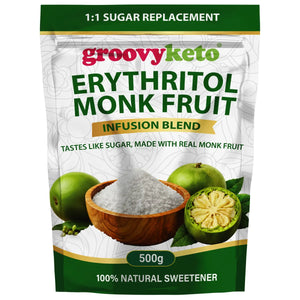
- A granulated sweetener melted into butter, in place of syrup. In our keto flapjacks, we melt our Monk Fruit Decoction & Erythritol Sweetener into the butter in place of sugar and golden syrup. Its ingredients are erythritol and monk fruit decoction, with soluble tapioca fibre as a carrier.
- A granulated blend, where only sweetness matters. Our Granulated Erythritol & Stevia Blend (erythritol and stevia glycosides) is the everyday option.
What to expect when you swap
Erythritol is a polyol, a type of carbohydrate our guide to what polyols are explains in more detail. It doesn't caramelise or melt into a syrup the way sugar does, so bakes can be paler and less sticky. Warm spices such as ginger, cinnamon and nutmeg help bring back some of treacle's depth. Our guide to low-carb sweeteners compares all the main options.

Free delivery is on orders over £30.
Frequently asked questions
Is black treacle the same as molasses?
Not exactly, but it's close. Black treacle is made from cane molasses blended with refiners syrup, while molasses is the syrup left after sugar is crystallised out of cane or beet juice. In baking, black treacle swaps 1:1 for light or dark molasses. Avoid using blackstrap molasses instead, as it's far more bitter.
Is black treacle the same as treacle?
Not always. In the UK, treacle can mean either of two syrups from sugar refining: black treacle, which is dark and slightly bitter, or golden syrup, which is also called light treacle. A treacle tart is made with golden syrup, while treacle toffee and most parkin recipes use black treacle. Check which one your recipe means.
Can I use golden syrup instead of black treacle?
Yes, in the same amount, as both are thick, sticky syrups. The bake will be paler, though, and taste of caramel and toffee rather than treacle's dark, liquorice-like notes. Lancashire parkin is generally made with golden syrup. For a darker colour, add a little dark brown sugar or a spoonful of treacle if you have some.
What is blackstrap molasses called in the UK?
There's no separate British name; it's sold as blackstrap molasses. Black treacle is the nearest product on most UK supermarket shelves, but it isn't the same. Blackstrap comes from the third boil of the cane juice, so it's darker, thicker, less sweet and more bitter. Use it only when a recipe asks for blackstrap by name.
What can I use instead of black treacle?
Light or dark molasses is the closest swap, used 1:1. Golden syrup or honey give the same stickiness with a milder flavour and paler colour. For lower-carb baking, a brown sweetener such as our Brown Erythritol & Stevia Blend can replace the brown sugar side of a recipe, but it isn't a syrup, so texture changes.
Sources
- Public Health England / Food Standards Agency. Composition of Foods Integrated Dataset (CoFID) 2021: food codes 17-826 (treacle, black), 17-059 (molasses) and 17-065 (syrup, golden), sheet 1.3 Proximates. Per-tablespoon figures are our own calculations.
- Tate & Lyle. Lyle's Black Treacle product specification (ingredients, description and nutrition), via KFF and Thompsons Food Service.
- King Arthur Baking (US). Light, dark and blackstrap: the different types of molasses, Baking with molasses and Ingredient weight chart (85g per quarter cup of molasses).
- World Sugar Research Organisation. Types of sugar from cane and beet (golden syrup and treacle).
- Wikipedia: Treacle, Molasses, Golden syrup, Parkin and Bonfire toffee.
- Groovy Keto product pages: Brown Erythritol & Stevia Blend, Monk Fruit Decoction & Erythritol Sweetener and Granulated Erythritol & Stevia Blend (ingredients, pack size and suggested use). Checked 28 October 2026.


